
For XAUUSD on MetaTrader 5
The discipline part, taken out of your hands.
ETA-CODE is a rules-based gold system that makes the decisions a good run tempts you into making badly — position size, the protective stop, when to stand aside — and makes them the same way every time, whether you are watching or not. You set one thing.
What your money has done.
Why it is not trading right now. Every opportunity examined, and the check that declined it.
What is at stake at this moment, and how far you are from your peak.
Its own record, kept honestly. The losses are on this page too.
Yours. Three buttons, and it never argues.
Figures are ATLAS, the agent the product ships with, over 31 of XAUUSD. A backtest, not a live account.
The problem
Most traders do not lose because the strategy was wrong
They lose after they start winning — and it follows the same shape almost every time.
Three good weeks, and confidence arrives.
A bigger size. Just this once.
The stop gets moved, to give the loss room.
Days before it recovers.
Look at those four again. Not one is a flaw in the strategy. Every one is a decision taken under pressure. The strategy never changed. You did.
That is a discipline problem — and a discipline problem has a solution.
What it is
There is one thing to set
You choose the trading agent. The sizing, the protective stops and when to stand aside are all resolved for you. There is no second decision, no settings file to load, and nothing to tune.
You choose
The trading agent
One of six temperaments, from the cautious one to the furthest out. That is the whole decision.
It resolves
Everything else
Position size, the protective stop, when to secure a gain, and when to stand aside entirely.
You paste
Your key, once
Issued against your account number, into the first box. There is no settings file to load and nothing to tune.
Why it was built this way
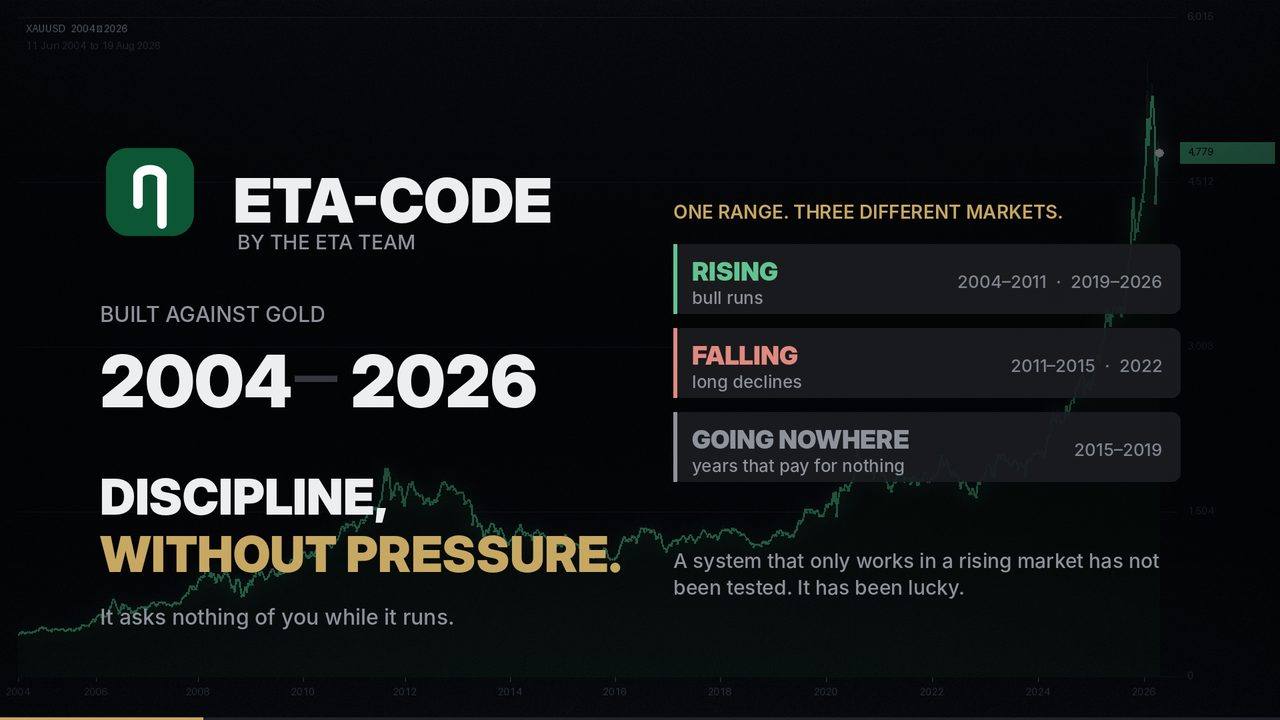
Built against twenty-two years of gold, not one good year
2004 – 2011, 2019 – 2026
Rising
Bull runs, where almost anything looks clever.
2011 – 2015, 2022
Falling
Long declines, where most systems are found out.
2015 – 2019
Going nowhere
Years that pay for nothing, where patience is the only edge.
A system that only works in a rising market has not been tested. It has been lucky.
The figures published on this site are measured over a shorter, recent window — 2024-01-01 to 2026-08-01, 31 months — so that every agent is compared on the same ground. That window contains no sustained decline, and we say so wherever a number from it appears.
Not a mock-up
This is the dashboard, on a real account
It is drawn on your chart while the system runs. It opens on a warning rather than a number, because at a small balance that is the honest thing to lead with.
- It warns you before it earns you anything. The red line at the top is the system telling you the balance is small enough that a bad market could end the account.
- Five pages, not one. Summary, Pipeline, Risk, Trades and Control — the tabs along the top.
- The quiet weeks are explained. Pipeline counts what was examined and names the check that declined it.
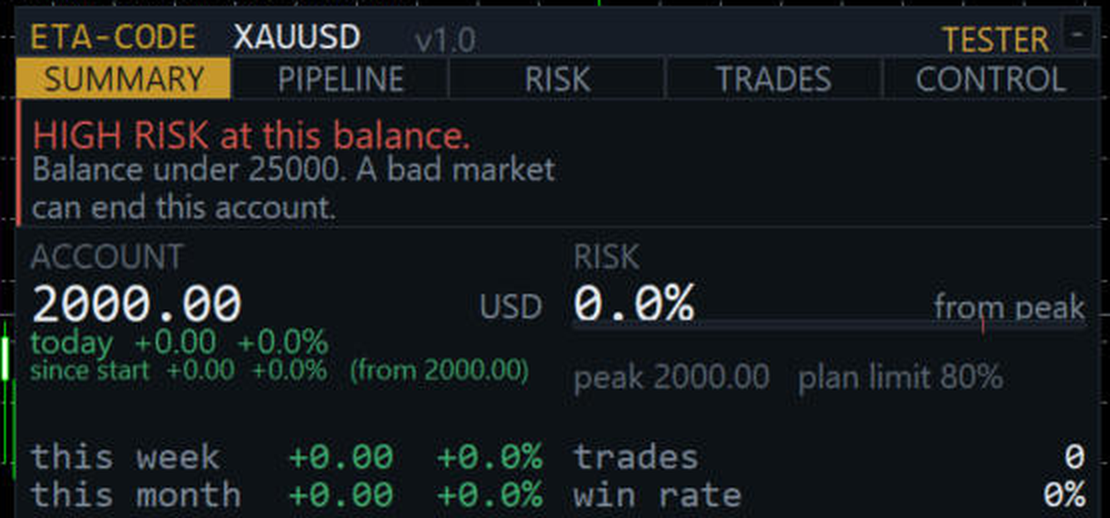
Captured from a strategy-test run — the TESTER badge is the terminal's own. A live account looks the same.
The evidence
Six agents, one deposit, the same 31 months
Every figure here is read from the strategy-test reports by a script. Nothing on this site is typed in by hand, which is the only reason it can be checked.
Where $2,000 ended, under each agent
ATLAS is the one the product ships with.
- ORIONthe cautious one$74,824
- VEGAthe forward one$197,400
- LYRA Normalthe standard LYRA$561,235
- LYRA Aggressivethe furthest out of the six$749,003
- DRACOthe one that waits to be convinced$75,899
- ATLASthe default$123,604
These are backtest figures. 2024-01-01 to 2026-08-01 on XAUUSD, H1, $2,000 deposit, 1-minute OHLC model, 15,184 bars at 99% quality. Measured on the customer binary, not a developer build. Past results do not predict future results and trading carries risk of loss.
The film
Seven and a half minutes, if you want the whole argument
What it does, every agent measured, the dashboard, and the downside stated plainly.
It is not published yet. Ask at hello@eta-code.com and it will be sent to you.
The downside, stated plainly
What it costs you when it goes wrong
ETA-CODE is no different: it draws down too. What separates instruments is how deep it goes, and whether anything is holding the bottom.
How far below your deposit each agent ever went
The full width is your whole deposit. Nothing is taken out to make these look better.
Measured against the whole deposit, nothing taken out. Four of the six never went below it at all — that is a zero, not a small number. And that is a bull market speaking, not a guarantee.
For scale
The same $2,000, in each of these
- Savings accountUS average rate, 0.38%$2,021
- High-yield savings1.59%$2,089
- One-year CD, rolled2.53%$2,143
- S&P 500dividends reinvested$3,397
- Gold, simply heldno leverage, no trading$3,974
- ETA-CODEon ATLAS — the one it ships with$123,604
Log scale — on a linear one every other instrument would be a single pixel. Each alternative is shown at its own best stretch in a decade, and given two months more than ETA-CODE because their figures run to today.
Each alternative is shown at its own best stretch in a decade, averaged by year. Theirs is what happened. Ours is a backtest. That difference matters and we are not going to bury it. It is not a shortcut. It is built for growth, not for speed. It will not make a million from a hundred. Nothing will.
Getting started
Discipline without pressure
Write to hello@eta-code.com and you will get a straight answer about price, terms and what you receive — from a person, within 24 hours.
Read the Risk Disclosure before you buy. Eleven points, two pages, and it is the honest version. Open the PDF.
Before you ask
The questions people actually ask
It has not traded for weeks. Is it broken?
Almost certainly not, and there is a page in the product that proves it. Open the dashboard, go to Pipeline, and it counts every opportunity it examined and names the check that declined each one. If that page is counting, the system is working — it is deciding not to trade, which is a decision, not a fault.
The longest stretch with no trade at all in the measured window was 56 days. That is normal and expected: the conditions it is willing to trade are not present in every market.
It is also why a term that produces no trades renews itself free of charge. You are never charged for a period in which the system stayed out.
Is this a martingale, or a grid?
No. Every trade carries a protective stop, placed as the position opens, and the system does not add to a losing position to average down. There is a hard limit on how much is held at once, and a floor at 70% of your deposit at which it closes everything and stops.
The honest difference: a martingale shows a smooth curve until the day it does not. This one shows its losing runs — the longest in the measured window was 18 trades in a row — and the account carried on.
Why should I believe a backtest?
You should not believe it in the way you would believe a bank statement, and we do not ask you to. A backtest is what the rules would have done over data that has already happened. It is not a record of money made, and past results do not predict future results.
What we can tell you is how it was measured, because that is where most published figures fall down. It is the customer binary, not a developer build — the two were run separately and compared deal by deal, because an earlier release went out with one filter compiled out and nothing but that comparison caught it. The model is 1-minute OHLC at 99% quality over 15,184 bars, and the window is stated beside every figure.
The measured window also contains no sustained decline. We say so everywhere a number from it appears, rather than leaving you to find out.
What happens when gold falls for years?
The short window above cannot answer that, which is why we do not pretend it does. One agent — the furthest out of the six — was run over the whole 2004–2026 record, which contains 2008, the four-year fall after 2011, and 2022.
Over that window it drew down further and gave back far more of a good year than anything in the 31-month figures. The numbers are on the evidence page. They are one agent over one window, so they describe no other agent — and they are the honest answer to this question.
How much work is it, day to day?
None, by design. You choose the agent and paste your key once. After that it runs on its own, and the dashboard is there for when you want to know what it is doing rather than because it needs you.
What it does need is a terminal that stays on. Positions are held for weeks by design, so a machine that is only open in the evenings will miss things. Most people run it on a VPS.
Can I run it on my broker?
If they offer gold and allow Expert Advisors, almost certainly. It reads which account type you have and sizes to it, so cent accounts and standard accounts both work.
If something about your setup is unusual, write to hello@eta-code.com before you buy and we will tell you honestly whether it will work. We would rather lose the sale than take money for something that will not run.
What if I change broker?
Costs nothing. Ask licence@eta-code.com for a reissue and the new key carries the same expiry date — not a fresh term, and not a shorter one. One licence covers up to three account numbers at a time.
What is the catch?
It is slow, and it is not a shortcut. It is built for growth rather than for speed: about one trade every 5 days, long stretches with none, and positions held for weeks. If you want something to watch, this is the wrong product.
It will not make a million from a hundred. Nothing will. And you can lose money with it — it is a tool, the account is yours, and the Risk Disclosure sets out the whole of that before you buy.